background

Friday, January 10, 2014

The Blue Mosque

The Sultan Ahmed mosque, better known to tourists as the Blue Mosque for its beautiful blue Iznik tiles, dates from  1609-11 and is still in use as a mosque today. From 1990 (I feel quite certain I didn't take the first photo, as I have no idea where you'd get this view from; I was taking slide photos at the time and you could buy slides then to supplement your own photos):


Now from 2013:


But I did take this one:


Hagia Sofia

A Greek Orthodox church built in 537, Hagia Sofia became an imperial mosque in 1453, and then was opened as a museum in 1935. It's been undergoing restoration of its dome for 17 (!) years, so some of these photos are from the 1990 trip, since otherwise you would be unable to see much for the scaffolding. First, another one of those unnaturally perfect exterior photos that must have been from a slide I bought:
This is rather more what it looked like when I was there!
Outside were carvings of the Lambs of the Apostles, dating from when it was a church.
Fountain outside for performing ablutions prior to prayer:


Notice the Virgin and Child in the dome above the windows:
I love the old-style chandeliers in mosques:

The domes aren't too shabby, either:
Some of the features of the main floor of the building:


There's a beautiful upper gallery in Hagia Sofia called the Loge of the Empress, where the Empress and court ladies could watch what was going on down below:


 Mosaic of Christ, probably 1261, flanked by Mary and John the Baptist:

Spiderweb detail in the corner of one the arches:


Mosaic of Christ flanked by Emperor Constantine and Empress Zoe:



Church of the Holy Saviour in Chora, Valens aqueduct, and Golden Horn

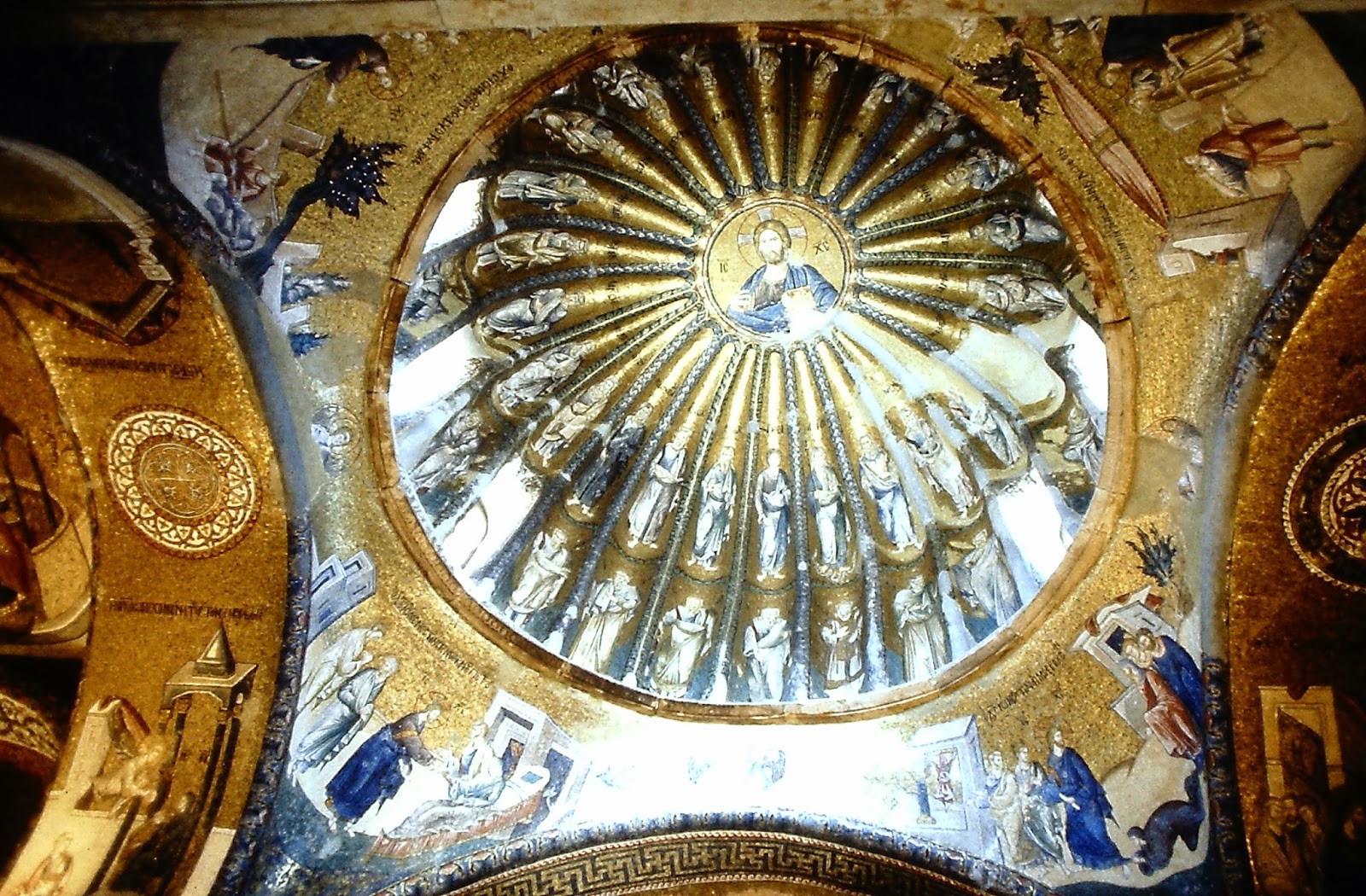
The Chora Church, 413-14, became the Kariye Museum in 1948, and has some gorgeous mosaics. We didn't revisit it on the most recent trip, but it deserves inclusion in a tour of Istanbul if you have the time, as I hope these 1990 photos prove:


In 1990, we also got a brief glimpse of the Valens aqueduct, built by Roman Emperor Valens in the 4th century AD:
And we climbed the hill to the Pierre Loti Cafe (he was a French Turkophile novelist who wrote a semi-autobiographical book about Istanbul in 1879) for a look over the Golden Horn, passing an old Islamic cemetery on our walk back down:


Topkapı Palace - gates and doors


Topkapı Palace (yep, there's no dot over the i, and it's pronounced "topkapa") was occupied by Ottoman sultans between 1465 and 1830, with 300+ rooms over four successive courtyards, as you can see in the model below.
Lots of courtyards mean lots of gateways. Babusselam Gate in the sunshine, 1990:
 Same gate, 2013 in the rain:


Even smaller doors are beautifully decorated: